


The complete guide
How to Choose a Big Dog Bed That Actually Lasts
The problem with most beds sold for big dogs
Walk into any pet shop and you will find plenty of beds labelled "large" that a Labrador would hang off. The size name on the tag is marketing, not a measurement. The second problem is depth. A lot of big beds are a thin layer of loose fibre inside a nice-looking cover, and under 30 or 40 kg of dog that fibre compresses to almost nothing within a month. The dog is then effectively lying on the floor through a sheet of polyester.
The third problem is cleaning. Big dogs make big messes. If the cover does not come off, or comes off only after a fifteen-minute wrestling match with a zip that stops halfway, it will not get washed. The bed starts to smell, you put up with it for a while, and then you buy another one.
A big dog bed that lasts solves all three at once. It is genuinely long enough, it has a base thick and dense enough to stay off the floor, and the cover comes away in under a minute.
How this bed is put together
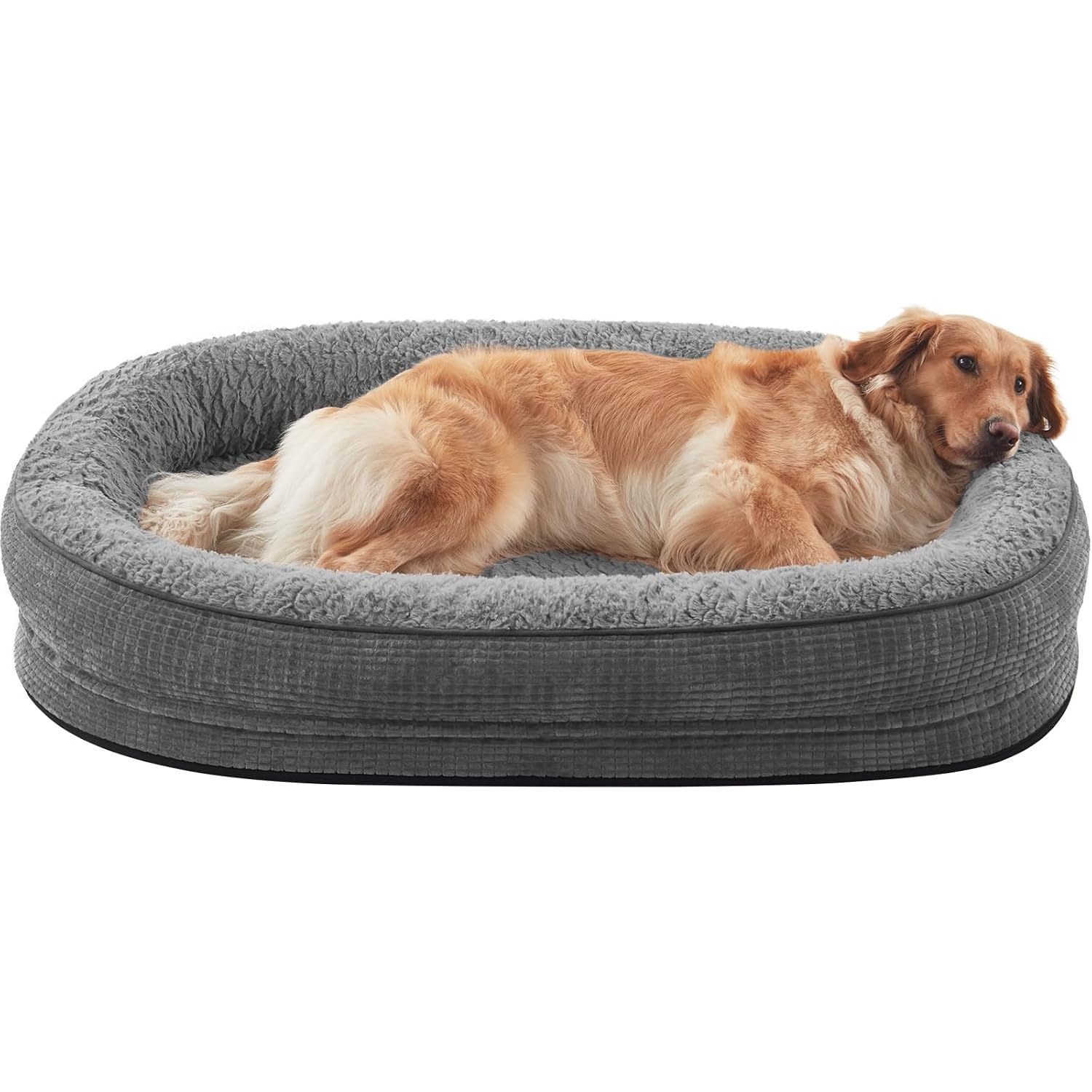
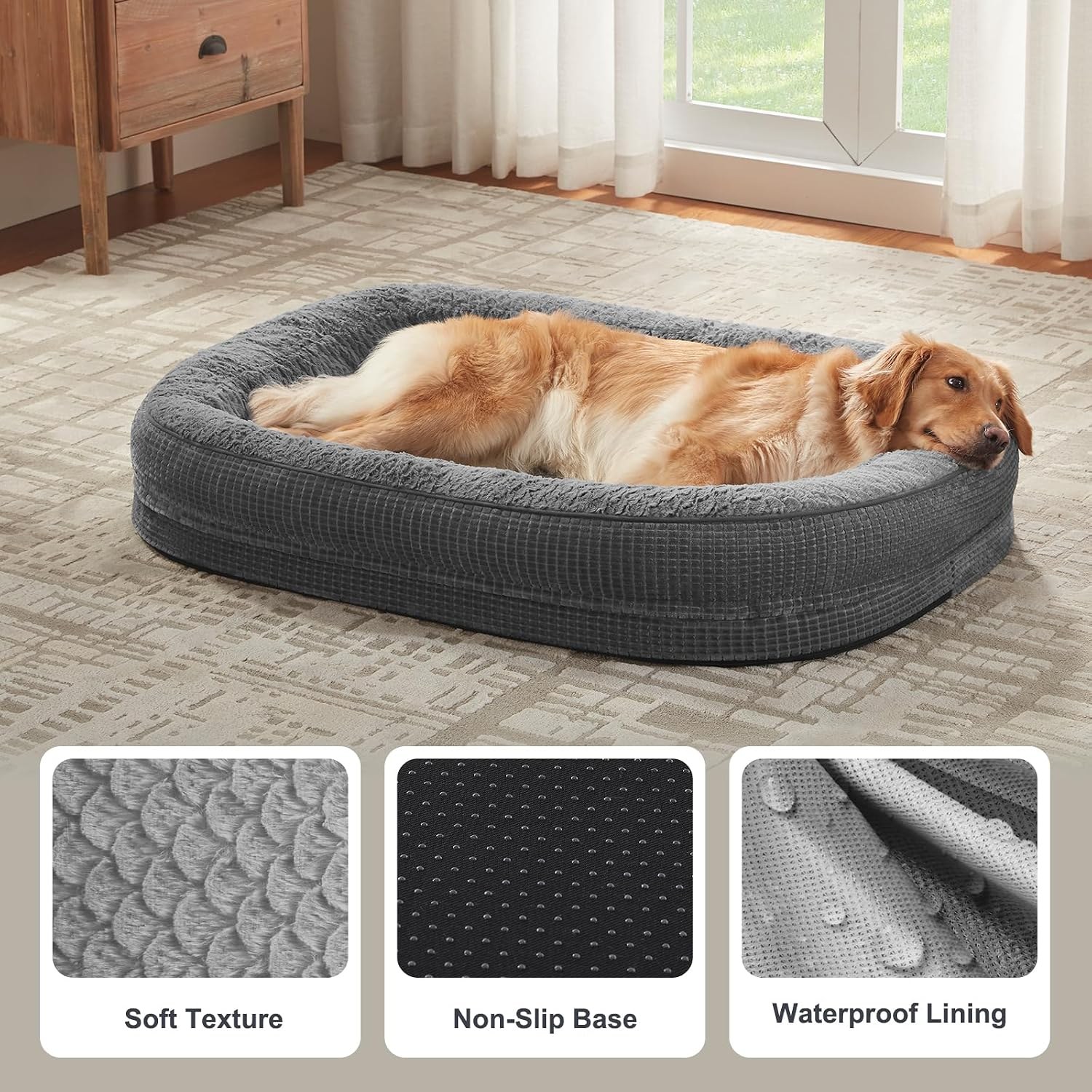
The sleeping base is 9 cm of high-density egg-crate foam. Two things matter in that sentence. The thickness gives you room to compress before you reach the floor, and the density stops the foam collapsing permanently. Egg-crate means the surface is moulded into peaks and valleys rather than being flat, so weight spreads across lots of small contact points and air can move through the gaps instead of being trapped under a hot dog.
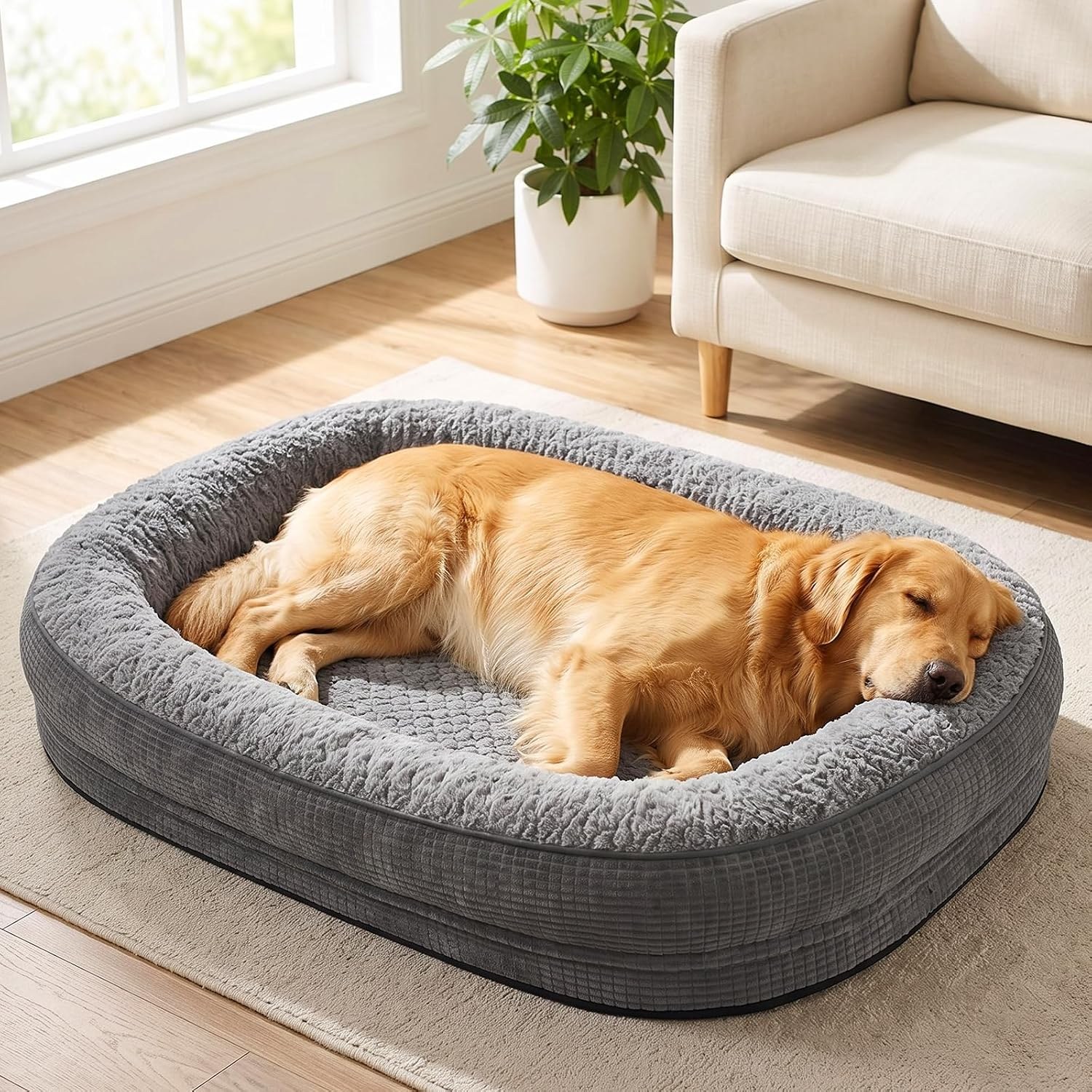
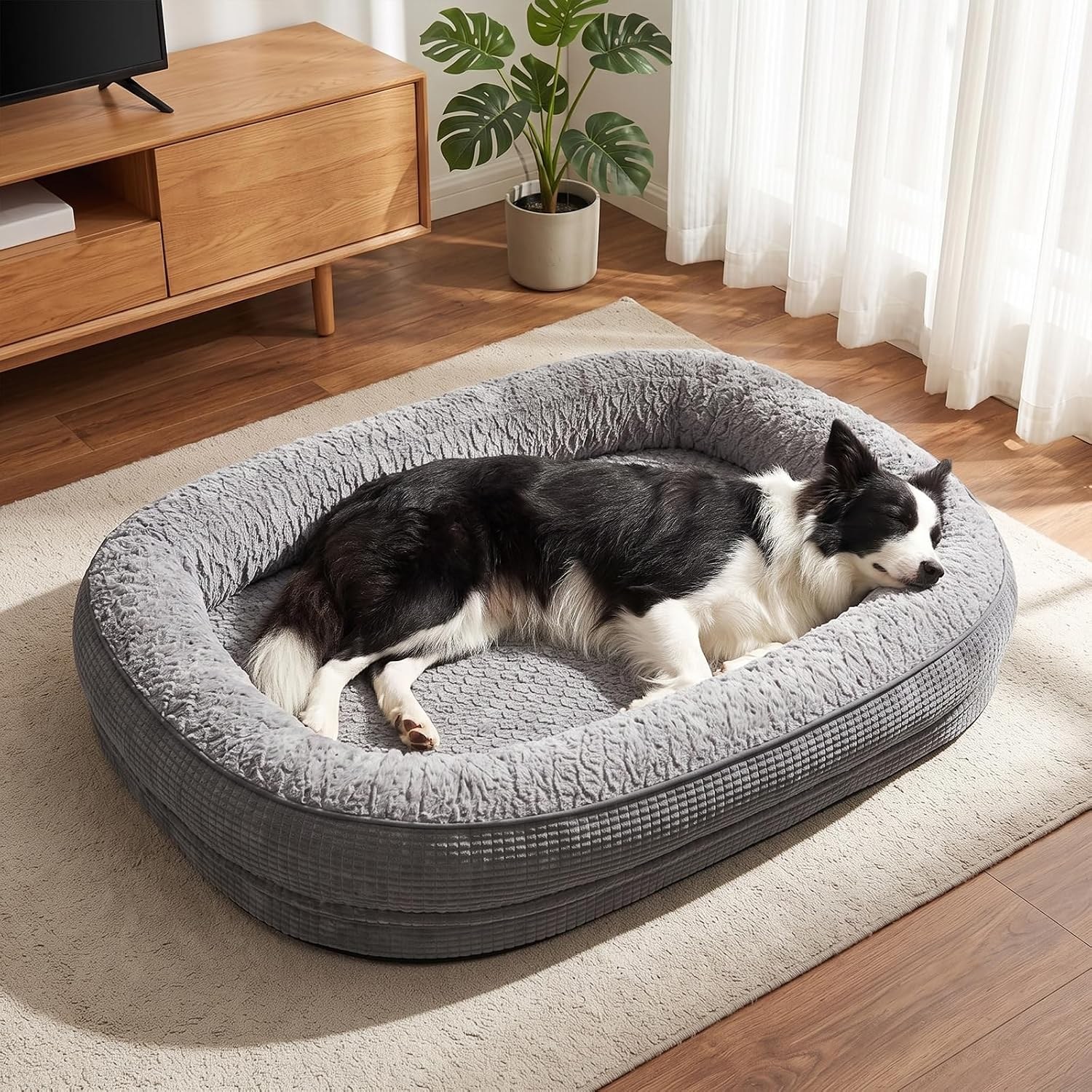
Around the outside runs the bolster, overstuffed with polyester fibre, going the whole way round. The front section steps down lower so the dog can walk straight in. That shape does a lot of quiet work. Curled-up dogs get something solid on every side. Sprawled-out dogs get a headrest wherever their head happens to land. Dogs that like to hook a paw over an edge get an edge to hook it over.
Between the cover and the foam sits a waterproof inner lining. This is the part people forget to look for and then regret. One knocked-over water bowl or one bad night and an unlined foam core absorbs the lot, which is very hard to fix. The lining means the mess stays on the washable layer.
The cover itself is polyester, with a soft fish-scale plush on the sleeping surface and a tougher corn-kernel texture fabric on the outside. It opens on a double zip and comes off completely for a machine wash. The whole bed is dark grey, and underneath there is an anti-slip bottom so the bed does not skate across wood or tile when your dog launches off it at the sound of the doorbell.
Picking between Large, XL and XXL
Here are the actual numbers. Large is 89 x 64 x 18 cm and the maker suggests it for dogs up to 20 kg. XL is 107 x 81 x 19 cm, suggested up to 34 kg. XXL is 122 x 89 x 19 cm, suggested up to 45 kg.
Use the weight figures as a cross-check, not as your decision. Weight tells you very little about shape. A 25 kg Border Collie and a 25 kg Bulldog need quite different footprints. Length is the number that counts.
So measure. Wait until your dog is lying on their side, properly stretched out rather than curled, and run a tape from the nose to the base of the tail. Write that number down. Then pick the bed whose length is comfortably more than it. If you land between two sizes, take the bigger one. A roomy bed is rarely a problem, and dogs that sleep stretched out need the extra centimetres that a curled-up dog does not.
Also think about where it goes. Measure the gap beside the sofa or the corner of the kitchen before you order. The XXL at 122 cm long takes a serious chunk of floor, which is fine if you have planned for it and annoying if you have not.
Who this suits, and who it does not
This is for dogs that like edges. If yours sleeps jammed into a corner, pressed up against a wall, or with a head draped over something, the full bolster is the point of the whole design. The same goes for dogs that curl tightly. The best dog bed with raised sides for that habit is one where the raised part goes all the way round rather than just along the back.
It also suits households with hard floors. The combination of a 9 cm base and a non-slip bottom is aimed squarely at wood, tile and laminate, where thin beds slide and offer very little padding.
It is less suited to a few situations. Heavy chewers can get through any fabric bed, and this one is not sold as chew proof. Dogs that have to sleep outside need a proper outdoor bed, because only the inner lining here is waterproof, not the cover. And if your dog insists on a completely flat sleeping surface with no walls, a plain mat will suit them better than a bolster.
Unpacking and the first few days
The bed arrives vacuum packed, which is how a bed this size fits in a sensible box. Open it, take it out of the plastic, and give it room. It needs up to 6 hours to expand to full shape. A warm room speeds this up, as does a good shake and a bit of hand-fluffing around the bolster. Do not judge the bed on hour one.
Some dogs climb straight on. Others need persuading. Put the bed where your dog already chooses to sleep rather than where you would prefer them to sleep, and add something with your scent on it for the first few nights. Resist moving it around while they are making up their mind. Dogs that have spent years on a hard floor sometimes take a week to decide that soft is acceptable.
Keeping it in good shape
Unzip the cover and wash it on a cool, gentle cycle with mild detergent. Skip fabric softener, because over time it coats plush fibres and flattens the pile. Air dry if you can. Heat is the main enemy of polyester plush and of zips.
Before the cover goes anywhere near the machine, pull the hair off. A vacuum with an upholstery attachment does most of it, and a rubber glove dragged across the surface pulls out the stubborn stuff that has worked into the pile. This protects your washing machine filter and gets a better clean.
The foam base does not get washed. Wipe the waterproof lining with a damp cloth and a little mild soap, then let it dry completely before the cover goes back on. Putting a dry cover over a damp lining is how beds start smelling.
Every few weeks, turn the bed around so your dog does not always lie in the same spot, and give the bolster a squeeze and a shake to redistribute the fibre. Small habits, but they are the difference between a bed that looks tired in six months and one that still looks fine in two years.
The short version
Measure your dog stretched out before you do anything else, then buy the size that is longer than that number. The 9 cm egg-crate foam base is what keeps a heavy dog off the floor, the bolster going all the way round is what makes it comfortable from any sleeping position, and the waterproof lining under a zip-off machine-washable cover is what makes it survive real life with a big dog. Give it 6 hours to expand, put it where your dog already sleeps, and wash the cover before it needs it rather than after.